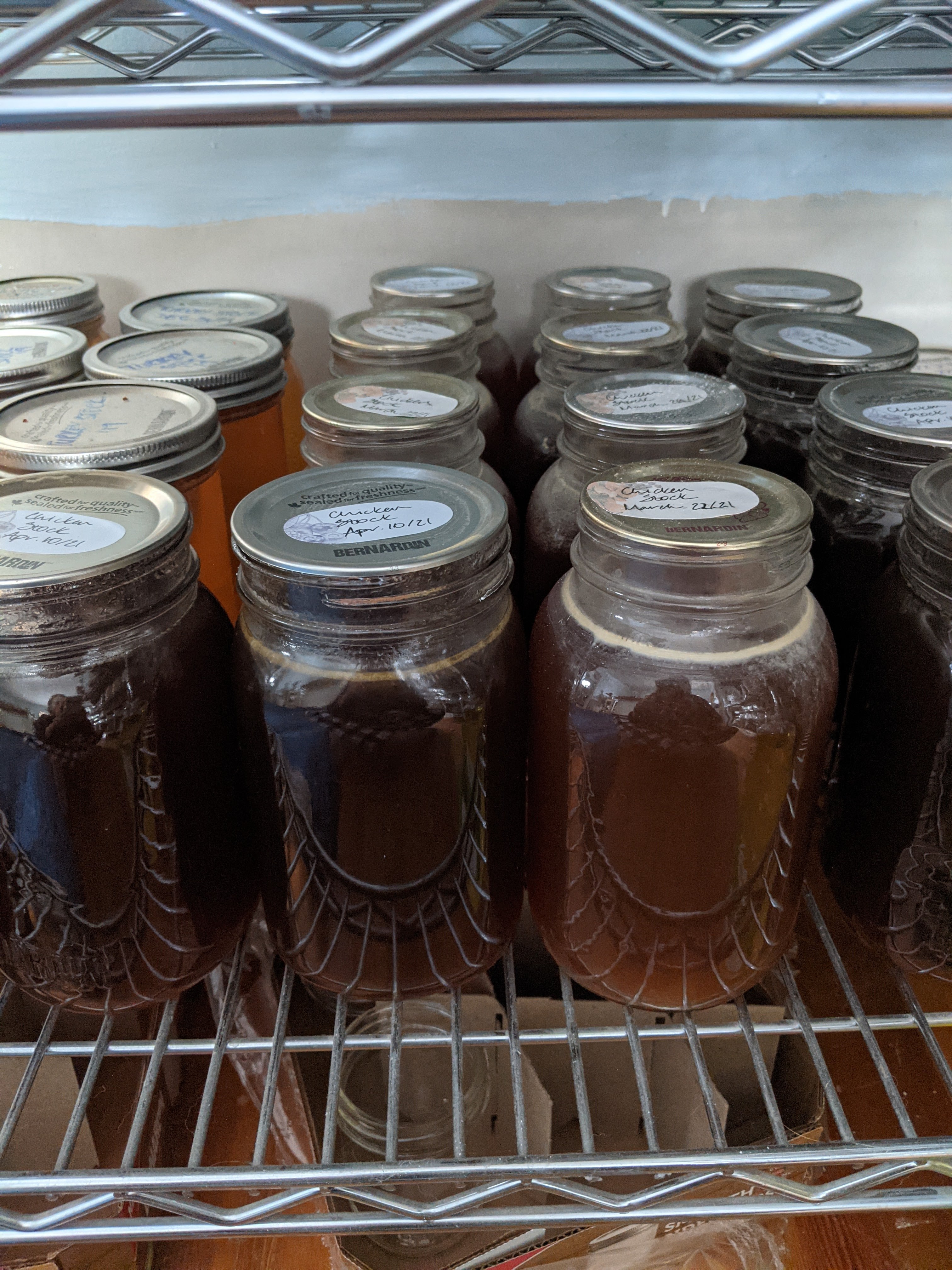
If I can convince anyone to make just one thing from scratch, it would have to be stock. There is simply nothing else that elevates home cooking in the same way, while cutting both grocery costs and food waste so dramatically. I use stock in so many dishes — soups, stews and risottos are obvious, but did you know that a bit of stock can loosen and add depth to a simple pasta sauce? You can cook grains in stock, you can make gravy with it. Stock makes almost every savoury dish better. But why make it yourself?
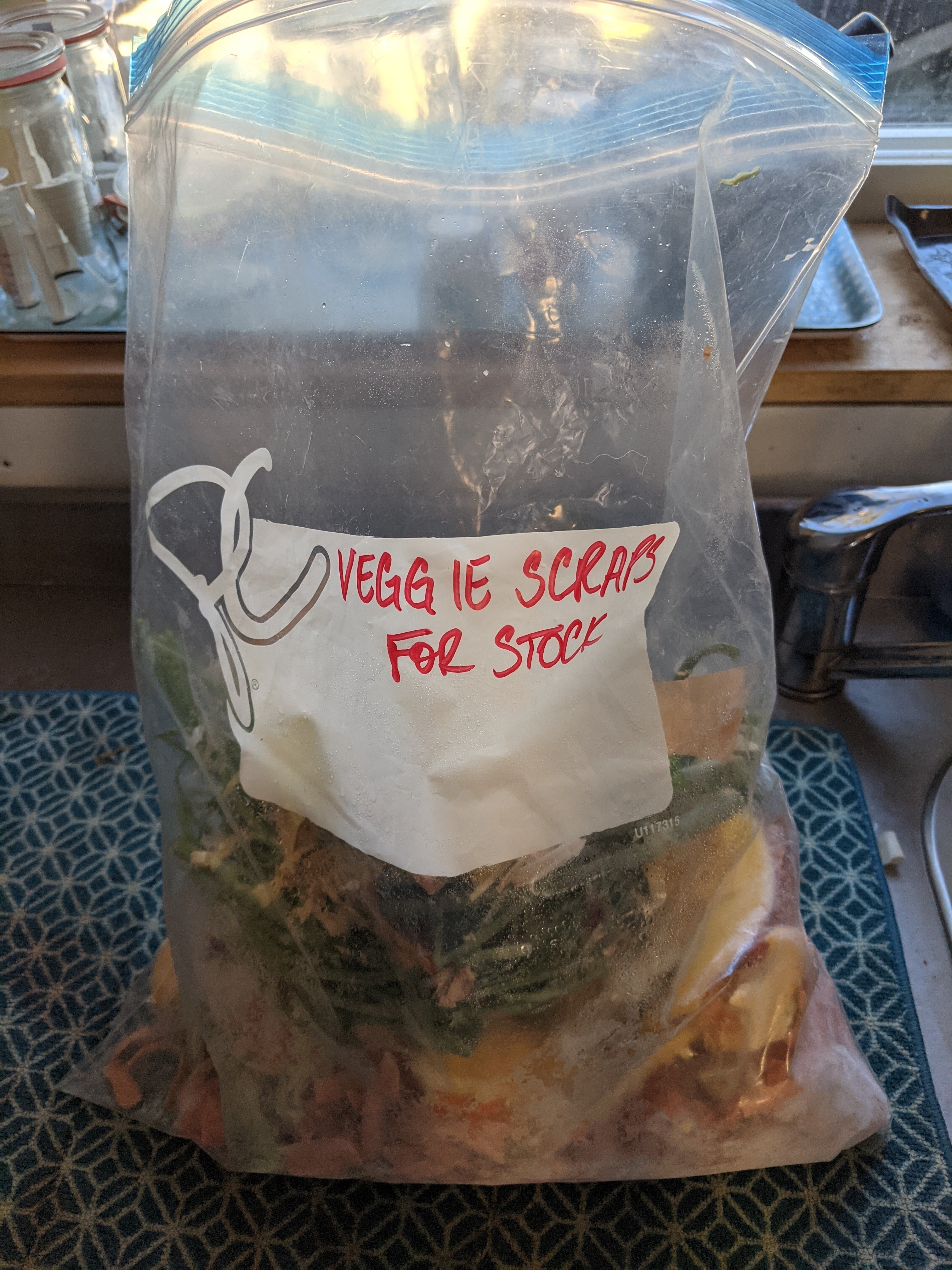
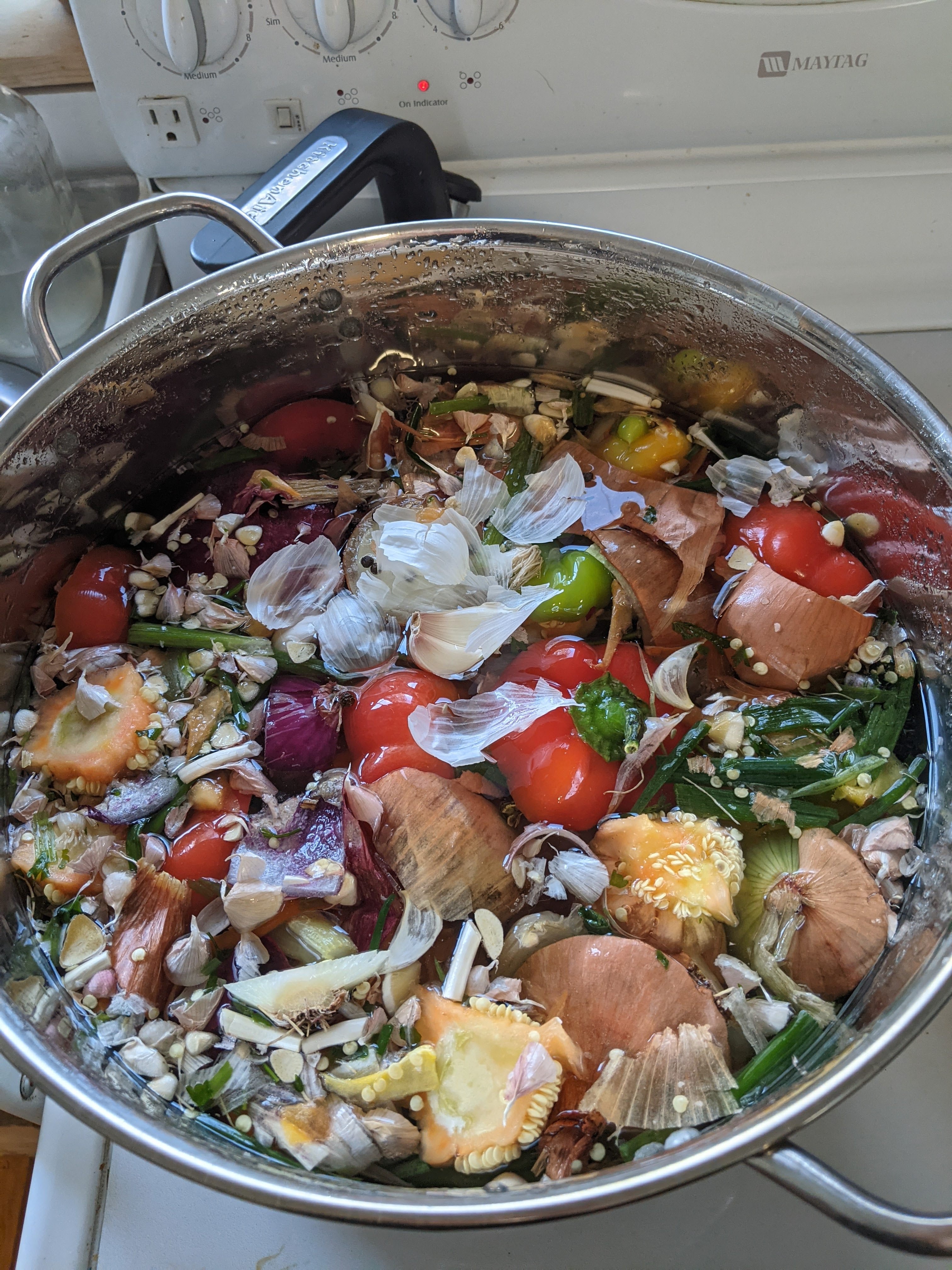
I make my own stock because it’s much cheaper, and because it prevents waste. Homemade stock also tastes much better than anything you can get in a carton, in my opinion. Stock can cost nothing, beyond the cost of acquiring equipment and energy used to cook it. I often make completely “free” stock, using up my scraps. I keep a box in my (newly re-organized!) freezer for my stock supplies — bags of vegetable trimmings and bones/carcasses from our meals. I will even save the bones leftover from chicken wing night! When my stored stock supply dwindles, I pull out my stockpot, throw in my scraps and a shot of apple cider vinegar, and cover everything with water. Sometimes, I make a vegetable stock; more often, I make chicken stock, since I use that the most in my cooking. After Thanksgiving and Christmas, I always make a huge batch of turkey stock, in this manner, which I find hugely helpful — I already have stock on hand for making gravy, and for basting the turkey, at the next holiday!
In addition to keeping bags of scraps for stock making, I sometimes buy ingredients with stock in mind. My favourite grocery store, Freson Brothers (an Alberta chain), sells flats and bags of chicken feet, for very little money. The look of the feet can be a bit unnerving, I cannot lie. One of my best friends said that she loves it when the feet bubble up to the top of the broth, and look like they are trying to claw their way out. While you may not enjoy their slightly macabre appearance, chicken feet are unparalleled for making excellent stock — they are full of collagen, which melts in the long, slow process of cooking stock, and enriches your finished product. Collagen-rich stock is not only highly nutritious, but it tastes better. (Incidentally, this is why slow-cooked, on the bone meats taste so great — they are also full of collagen, which improves both their taste and their “mouth feel”.) I include apple cider vinegar, or a splash of white wine, in my stocks, because the acid they contain helps to extract the collagen from the bones in my broth.
Of course, if you are vegetarian, you can keep your stock strictly meat-free, and it will still improve your cooking tremendously. I like to make and keep some vegetable stock on hand, for our vegetarian meals and for soups and other dishes where the taste of meat stock might be too strong. If you are making vegetable stock, I would strongly suggest that you include some whole, fresh vegetables, in addition to your scraps. I always like to use an onion, a couple of carrots, and a stick or two of celery — I am nothing, if not classic. You don’t need to peel your vegetables, though you should wash them to remove any dirt or residue. Onion peel actually helps impart a lovely golden hue to your finished stock. I also made some asparagus stock last year, to use when making asparagus soup. It’s an easy way to reinforce the flavour in a simple dish.
Once the ingredients are in the stockpot, and well-covered with water, I add some simple flavourings. In terms of herbs, there are always stems and such from parsley in my scrap bag. I will usually add a couple of bay leaves and a handful of whole peppercorns. I don’t like to add too many other herbs, because I want my finished stock to be as versatile as possible, and to be usable in many different preparations. I don’t want to add a “minty” stock, for example, to a bolognese-style sauce. I do add salt to my stock, because I think salt is important in good home-cooking and because my family doesn’t have to avoid sodium for health reasons. Like the question of sugar in homemade jam though, I think that the salt in commercially-processed foods and restaurant meals is a far greater health concern than the use of minimal amounts of salt in home-prepared, from-scratch foods. In fact, one of my reasons for making my own stock is that I am able to control the amount of salt in my food. A good handful of kosher salt in a pot of nearly 10 litres of homemade stock is not a reason for concern, for my family. But, if you cook for someone with blood pressure concerns, or other cardiac disease, it can be great to know, beyond hesitation, that the stock you are using contains absolutely no salt.
With everything ready to go, I bring my stock up to the boil fairly slowly. Making stock this way is a long process, and rushing just results in stock that isn’t as rich or tasty as it could be. The great thing is, this is almost entirely hands-off cooking. Just put your pot on a burner, and check in on it every so often. You don’t need to hover. I have encouraged both my daughters to make stock on their days off (the weekends, when they were students) because it is entirely compatible with doing homework, doing housework, or working on other projects while the stock cooks. Once it comes to a boil, I turn the heat right down to low, so that only the occasional bubble breaks the surface. Then I leave it. For days. Yes, really. My stock cooks very slowly, at the back of my stove, for days on end. You may have more intense fire-safety concerns than I do, and worry about leaving a burner on overnight, or you may not be a hermit like me, and actually leave your house sometimes. In that case, I encourage you to cook your stock for as long as you can. Stock cooked for a few hours on a lazy Saturday is EXCELLENT. I am just very lazy.
Another great way to make excellent stock, without holing yourself up for days without falling asleep, involves one of my favourite kitchen tools — my Instant Pot. I believe in, and practice, low-tech cooking the vast majority of the time, and I hate single-use kitchen gadgets. I don’t believe that you need anything more than a burner and a big (cheap!) pot to make great stock. But. I love my Instant Pot for prepping all kinds of “ingredients” — like stock, yoghurt, and beans — and if you can afford one and have the space, I would recommend one. (I plan to blog about this, but I don’t cook many complete “meals” in my IP, and use it mostly for prep. I bought my older daughter one though, and she loves cooking in it!) Outstanding, collagen-rich stock can be made in an Instant Pot (or other electronic pressure cooker) in a little more than two hours, from start to finish. Like stock pot stock, I start by putting scraps in the pot, along with a shot of acidic liquid, seasoning, and as much water as will fit. You can fill the pot right to the Max Fill line with no averse consequences. I most often use my chicken feet in the IP, because they take up less space than a whole chicken carcass, and because the pressure of the cooking method is particularly good for extracting collagen. I put on the lid, making sure that the pressure valve is set to closed, press the Manual setting (high pressure), and set the timer to ninety minutes. Then, I walk away. That’s it. That’s all I have to do until the IP sings its “I am finished” song. Even better, the pot can also naturally depressurize. There’s no rush.
Now, certain chefs, cookbook writers and YouTube food vloggers will insist that there are all kinds of rules to making stock. You must roast the bones. You must skim the stock at set intervals. You must rinse your bones multiple times. You must only use the highest quality, most expensive, organic ingredients available. You must call it “bone broth” and only cook it at the waning moon. And so on. I do none of this. Every so often, I might get a surge of energy and momentum, and attempt to skim my stock. This never lasts longer than five minutes, as I remember that it’s a never-ending battle against impurity, and no one is going to be awarding Michelin stars at my dinner table. Heck, I don’t actually have a dinner table. I bring my stock to a boil, turn it down to low, and ignore it for a very long time. Then, I line a sieve/colander with a few layers of cheesecloth (if you try many of my projects, you will need to buy some of this stuff. It’s cheap, and despite what it says on the package, it’s totally reusable), and place it over a big pot, bowl, or container.
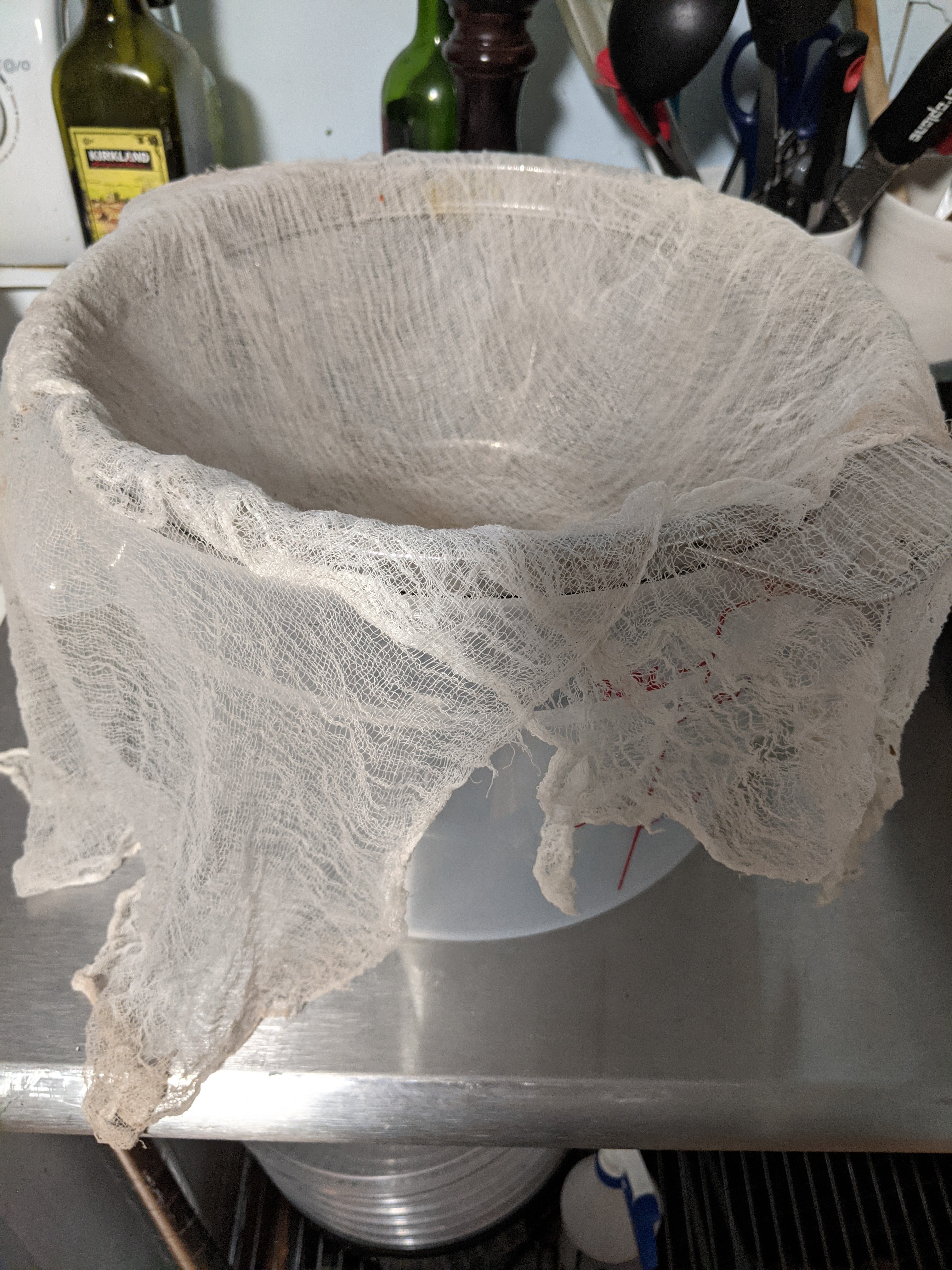
My next step is to strain my stock. If I have made Instant Pot stock, I can usuallly manage to carefully pour the contents of the pot through the sieve/colander set-up without splashing myself or dumping mushy vegetables and bones on my counter-top. Usually. But if I have made a large stockpot’s worth, I need to carefully ladle the hot liquid into my straining apparatus. This can take a while. Again, making stock is a slow process. Then, I let the stock cool on the counter. (Food safety tip! You do not want to put a big pot or bowl of a very hot liquid in your fridge to cool! It will increase the temperature in there, very quickly, which means that all your other food may move out of the safe temperature “zone”. Only put room-temperature food in the fridge!)
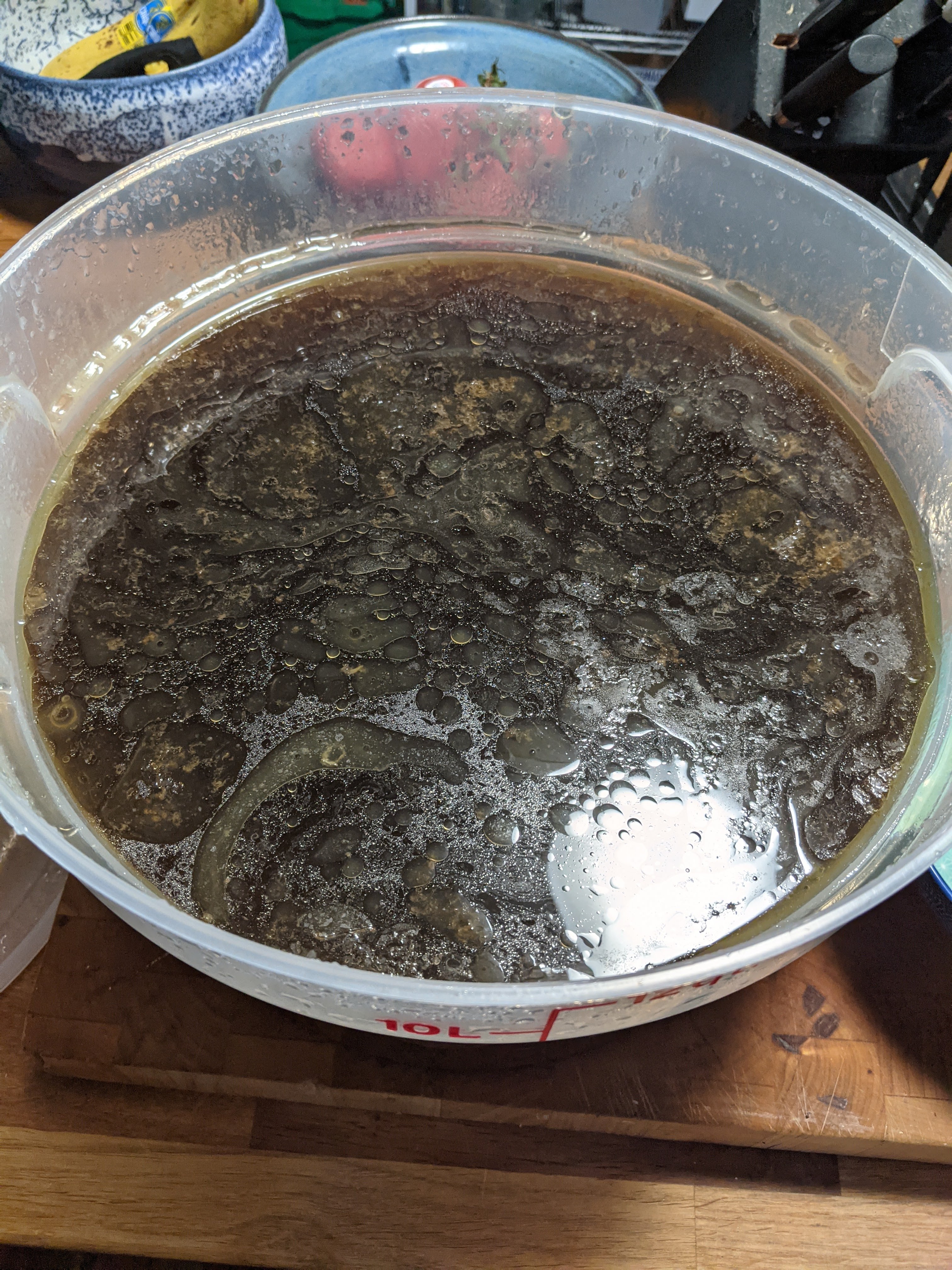
Once the stock has cooled down, it can and should go into the fridge. I do my best to remove all the skin from my chicken parts, before stock-making, but it’s unavoidable that some skin and other fatty bits make their way in. That’s why you see a slick of grease on the top of my stock in the picture above. I feel very strongly about the way that our disordered food/eating culture has demonized fat, with terrible consequences for our collective health. It’s not advisable to eliminate all fat from our diets. Fat is a macro-nutrient, vital for healthy skin and hair, and for proper brain development in children. Also, certain important micro-nutrients are only fat-soluble. That means that they don’t dissolve in water, but in fat, so the only way for us to get them in our diets is to consume reasonable amounts of healthy fats. And again, despite the keening from some elements of our diet culture, animal fats are not inherently unhealthy. All this is to say, don’t get too worried about the fat on the top of your stock. I do “de-fat” my stock somewhat, simply to make sure that it doesn’t taste “greasy”. This is a terribly technical process — I leave the stock in the fridge overnight, and then I lift off the layer of fat that has solidified on top in the cool fridge environment. I told you, I am lazy.
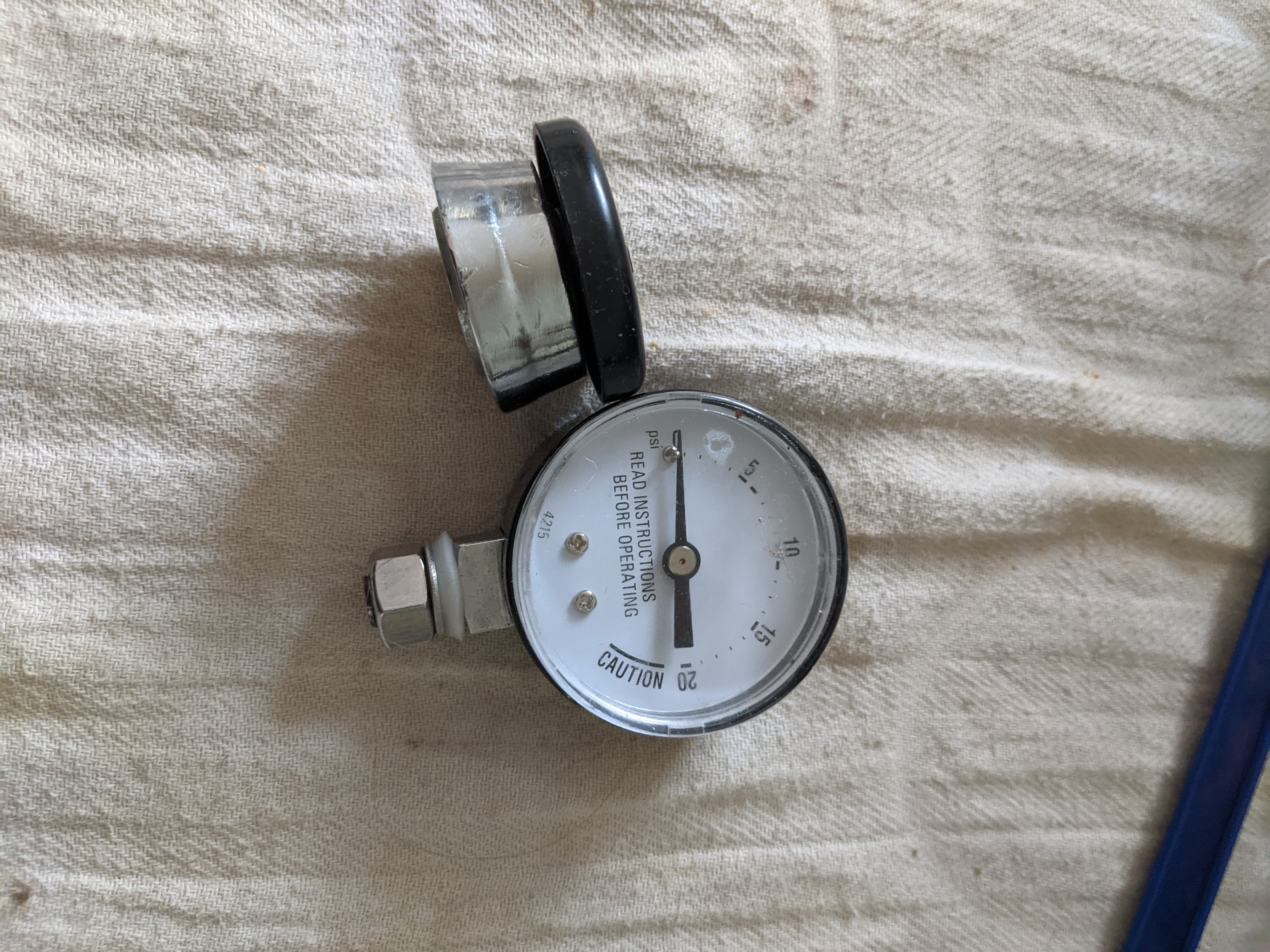
Once the fat has been removed from the stock, it’s ready to use. Chances are good that we will have risotto for dinner, fairly soon after I make a batch of stock. If you make stock in the IP, or if you don’t have a giant pot to make stock in, and thus make smaller batches, you can keep your stock in the fridge. It should keep for three to four days (perhaps slightly longer). A small batch of stock is perfect to make soup with, especially if you happen to also have some leftover chicken to throw in your stock. Another option, if you have it, is to freeze your stock. In the freezer, stock will keep for at least three months, and probably much longer, especially if you make sure that it is cold when it goes in. ALWAYS LABEL EVERYTHING YOU PUT IN YOUR FREEZER, AND INCLUDE THE DATE! I say this out of love, so you won’t repeat my mistakes. These days, I keep a roll of painters’ tape and a sharpie in a small, magnetic container on my fridge, for all labeling emergencies. It’s not Martha Stewart-level, beautiful organization, but it does the job. Which is reminding me to use stuff that I worked to make. Anyway! You can freeze stock in plastic containers (do you, perhaps, share my addiction to saving old yoghurt tubs?), or in ziploc bags, if you can be certain that you have closed them completely. I cannot. I used to store all my stock this way. It’s great to have this cheap/free ingredient on hand. However, a few years ago, I invested in a bulky and somewhat terrifying piece of kitchen equipment that revolutionized my stock portfolio (you knew there was going to be another bad pun here), as well as so many other aspects of my kitchen life. And I am not going to share it with you until my next post. I am so mean. Here’s a teaser…
 Supermarket Homestead
Homemade stock is one of my favourites! It’s so versatile, & I try to make some whenever I can!
Thanks for the tips, I’ll add them to my repertoire!
LikeLike